




If you’re preparing for the NEET exam, one question probably keeps coming back: “How many marks do I need for a good rank?” This is where understanding NEET Marks vs Rank becomes extremely important.
Many students focus only on marks, but in reality, their rank determines their future. Whether you get into top-ranked colleges, a decent government seat, or a private medical college. So instead of just chasing a number, it’s smarter to understand how marks actually translate into rank.
What is NEET and Why Marks vs Rank Matters?
The NEET exam (National Eligibility cum Entrance Test) is the single entrance exam for admission into medical colleges across India. Every year, lakhs of students compete for a limited number of seats, making the competition intense.
While marks reflect your performance in the exam, your rank tells you how you performed compared to others. Even a small difference in marks can lead to a huge jump in rank, especially at the top level. That’s why understanding NEET Marks vs Rank helps you plan your preparation more realistically.
NEET Marks vs Rank: Quick Overview (2026 Expected Trends)
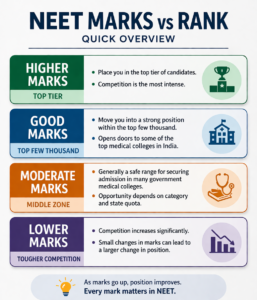
The relationship between marks and rank on NEET is not fixed and varies slightly each year, depending on factors such as paper difficulty and student performance. However, based on recent trends, we can get a fairly accurate idea of what to expect in NEET 2026.
- Students scoring above higher marks usually fall within the top tier, where competition is the most intense.
- As marks gradually decrease, ranks typically move into the top few thousand. This is still a strong position and can open doors to some of the top colleges in India.
- Once you move into the middle zone, ranks generally fall between 5,000 and 20,000. This range is often considered a safe zone for getting into many government medical colleges, depending on your category and state quota.
As marks drop below 550, the rank difference becomes even wider. Students scoring between 500 and 550 marks may find themselves in the 50,000 to 1,00,000 rank bracket. Below 500 marks, ranks usually go beyond 1 lakh, making government seats more difficult but not impossible through other quotas or private medical colleges.
The key thing to remember here is that these are not exact numbers, but practical benchmarks. Even a difference of 10–15 marks can shift your rank significantly, especially in the higher score range.
Factors Affecting NEET Rank
The connection between NEET Marks vs Rank is influenced by multiple factors, not just your score.
- The difficulty level of the paper plays a major role; if the exam is tougher than usual, even slightly lower marks can fetch a better rank.
- Another important factor is the number of candidates. With over 20 lakh students expected in NEET 2026, the competition is only increasing.
- Students’ overall performance also matters. If many candidates score highly, the rank distribution shifts, making it harder to secure top positions.
- Tie-breaking rules also apply when students score the same marks. In such cases, Biology marks are given priority, followed by Chemistry and then the number of incorrect answers.
What Rank is Needed for Top Colleges?
If your goal is to get into top-ranked colleges, your rank needs to be competitive.
- For premier institutes like AIIMS and other elite government institutions, ranks under 100 are usually required.
- For well-known state government medical colleges, a rank within 5,000 is generally considered safe.
- Even ranks up to 20,000 can help you secure a seat in decent government medical colleges, especially depending on your state quota.
- Beyond that, private medical colleges become more realistic options, although they come with higher fees.
Marks Required for the Best Medical College
To get into the best medical college, aiming for high marks is essential. A score of 650 or above puts you in a strong position for top government colleges. If you’re targeting elite institutions, pushing your score to 680 or even 700+ can significantly improve your chances.
At this level, the competition is extremely tight, and accuracy becomes more important than attempting every question. Many top rankers succeed not because they attempt more questions, but because they make fewer mistakes.
NEET UG 2026: What Should You Target?
Setting a target for NEET UG 2026 should be based on your current preparation level rather than just aiming blindly for a high score. If you’re just starting, it’s more practical to first focus on building a strong foundation and completing the NEET syllabus thoroughly. In this stage, even reaching the 500-mark range is a solid achievement. As your preparation improves, your target should gradually increase.
- Students who are already comfortable with the basics should aim to cross 600 marks, as this is the range where serious competition for government seats begins.
- At this stage, regular mock tests and detailed analysis become crucial.
- For advanced aspirants who are consistently scoring well in mocks, the goal should shift toward 650+ marks. This is where you start competing for top-ranked colleges.
- The focus here should not just be on studying more, but on improving accuracy, managing time efficiently, and avoiding negative marking.
Instead of setting one fixed target, it’s better to have progressive goals. This approach keeps you motivated and helps you improve steadily without feeling overwhelmed.
Understanding the NEET Syllabus
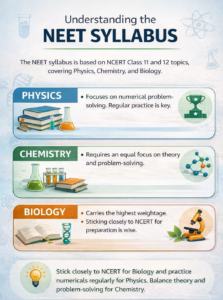
The NEET syllabus is based on NCERT Class 11 and 12 topics, covering Physics, Chemistry, and Biology. Among these, Biology carries the highest weightage, making it a scoring subject if prepared well.
A smart approach is to stick closely to NCERT, especially for Biology, while practising numerical problems regularly for Physics. Chemistry requires a balanced approach, with equal focus on theory and problem-solving.
Role of Coaching and NEET Class
Many students opt for a NEET course or join a NEET class to stay disciplined and guided throughout their preparation. Coaching institutes provide structure, regular testing, and expert mentorship, which can be helpful. However, it’s important to understand that coaching alone does not guarantee success.
- Self-study, consistency, and proper revision play an equally important role.
- Even students without coaching have cracked NEET with the right strategy.
Strategy to Improve Your Rank
Improving your NEET Marks vs Rank outcome requires a combination of smart work and consistency.
- Instead of studying randomly, focus on high-weightage topics and revise them multiple times.
- Regular mock tests help you understand your weak areas and improve time management.
- Accuracy is another key factor. Since NEET has negative marking, avoiding unnecessary risks can significantly improve your score.
- Learning from mistakes and maintaining consistency over time can make a huge difference in your final rank.
Common Mistakes Students Make
One of the most common mistakes students make is ignoring NCERT textbooks, especially for Biology. Many also fail to analyse their mock tests, which limits their improvement. Another issue is focusing only on strong subjects while neglecting weaker ones. Balanced preparation is essential for scoring well overall. Last-minute cramming and poor time management also affect performance negatively.
NEET 2026: Expected Competition Level
With increasing awareness and access to online resources, the competition for NEET 2026 is expected to be even tougher. More students are preparing seriously, which means cut-offs may slightly increase.
In such a scenario, consistency becomes your biggest advantage. Students who study regularly and revise effectively tend to perform better than those who rely on last-minute preparation.
Final Thoughts
Understanding NEET Marks vs Rank gives you clarity and direction in your preparation journey. Instead of stressing over rank alone, focus on improving your marks step by step.
A small increase in marks can lead to a big jump in rank, especially at higher levels. With the right strategy, consistent effort, and smart preparation, you can move closer to your dream of getting into the best medical college. Stay focused, trust the process, and keep improving every day.

