




Every year, lakhs of students appear for NEET MBBS hoping to secure a Government MBBS seat in a medical college. But many are unsure about a critical question: how many marks do you actually need to get into a government MBBS college? This guide breaks it all down clearly.
The dream of becoming a doctor in India runs through a single gate: the NEET exam. Whether you want to study at AIIMS Delhi or at a state government college in your home district, your NEET score is everything. And yet, year after year, students either over-prepare with unrealistic targets or drastically underestimate what it takes to land a government MBBS seat. The reality is that the minimum marks needed for government MBBS seats vary quite a bit depending on the category of the candidate, the state, and the type of institution. Let us walk through all of this clearly so you know exactly where you stand.
What is NEET and Why Does It Matter for MBBS Admissions?
The NEET paper is a national-level entrance examination conducted by the National Testing Agency (NTA). It is the only gateway for admission to MBBS seats across all government and private medical colleges in India. Whether you are aiming for top Indian medical colleges or a state-run institution, your rank in NEET determines your fate.
The exam is conducted for 720 marks in total. It covers Physics, Chemistry, and Biology (Botany and Zoology). To even be eligible for the general merit list and compete for an MBBS seat, you first need to qualify, and qualification itself requires a minimum percentile, not just a score.
Qualifying for NEET and getting into a government medical college are two very different things. Lakhs of students qualify every year, but only around 50,000 government MBBS seats are available across India. That gap is where the real competition lies.
NEET Cutoff: Qualifying vs Competitive
There are two layers of NEET cutoff that students often confuse.
- The Qualifying Cutoff – This is the minimum percentile set by NTA to be eligible. The cutoff varies by category. While general category candidates are held to a higher bar, SC, ST, and OBC candidates are subject to a slightly relaxed threshold.
- In real marks, general category students have historically needed a score that clears a fairly demanding threshold, and that number tends to move a little each year.
- Qualifying is essentially just getting your foot in the door. It doesn’t get you anywhere close to an actual government MBBS seat.
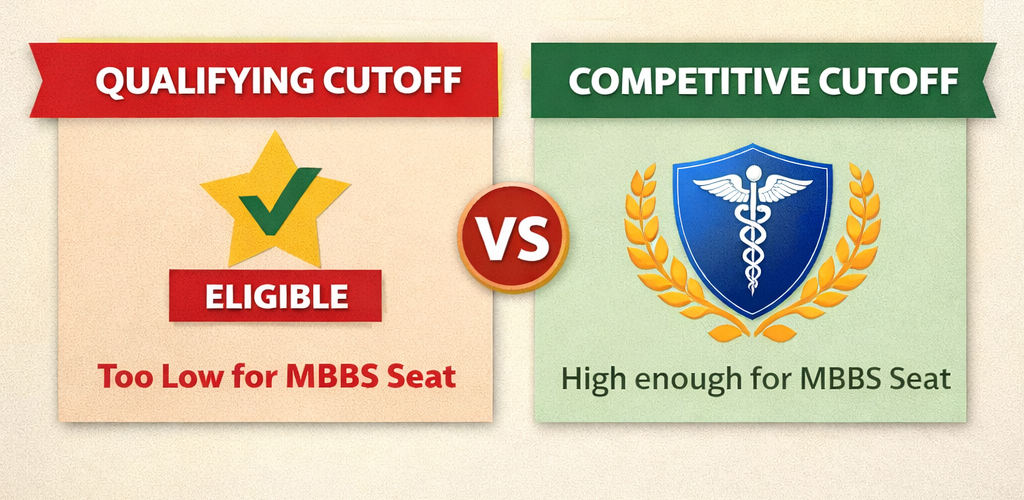
- The Competitive Cutoff for Govt Medical Colleges – This is where the real target lies. To actually secure an MBBS government college seat, especially through the All India Quota (AIQ), your score needs to be significantly higher than the qualifying cutoff.
- All India Quota vs State Quota: How It Affects Your Target
- One thing many students do not fully understand is that MBBS govt college admissions happen through two separate pools of seats:
- All India Quota (AIQ) covers 15 per cent of seats in government medical colleges and 100 per cent of seats in central institutions like AIIMS and JIPMER
- State Quota covers the remaining 85 per cent of seats in government colleges, managed by individual state counselling authorities.
- The AIQ cutoff is generally higher and more competitive because students from across India compete for those seats.
- State quota cutoffs, on the other hand, can be lower, especially for candidates who belong to that particular state and can leverage domicile-based reservations.
- For example, a student in a less competitive state might secure an MBBS govt college seat with a score of 450+ through the state quota, while the same score would not be enough for AIQ general category seats.
- This is why researching your state-specific NEET cutoff is just as important as knowing the national average.
Top Indian Medical Colleges and Their NEET Score Requirements
If you are targeting top medical institutions in India, the bar is significantly higher. Here is what you are looking at for some of the most sought-after government institutions:
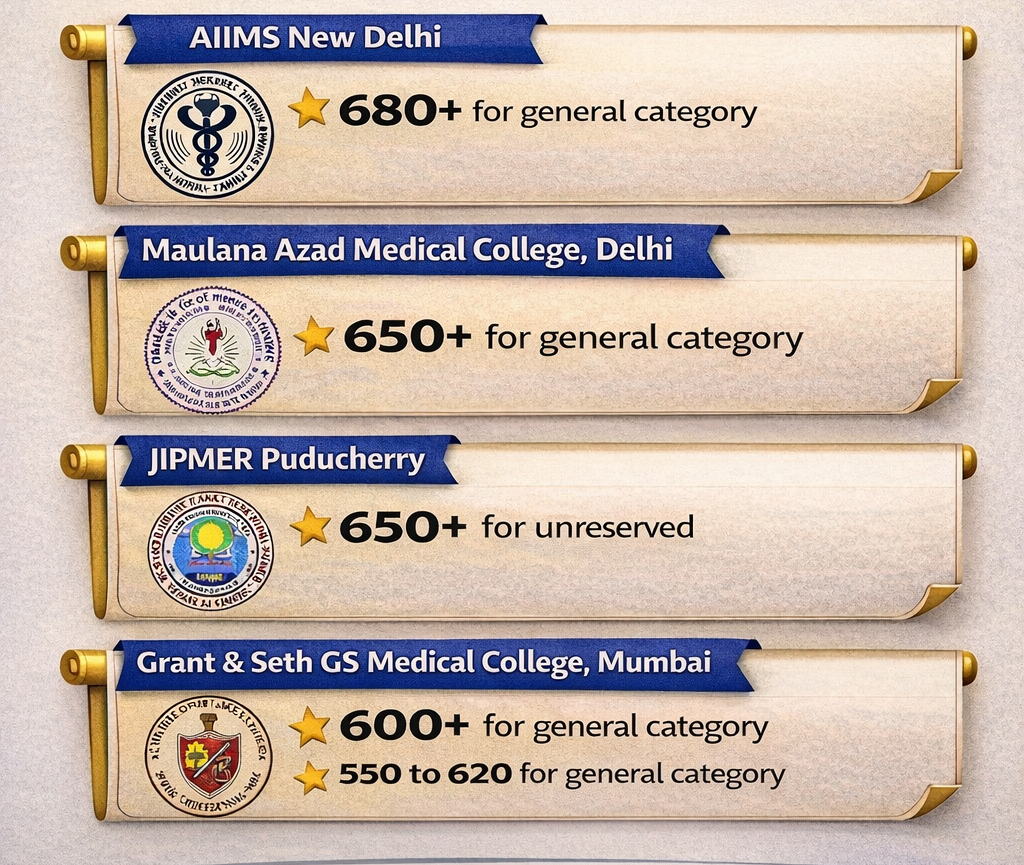
- AIIMS New Delhi typically requires a score of 680 or above for general category candidates
- Maulana Azad Medical College, Delhi, one of the most competitive state government colleges, generally requires 650 or above.
- JIPMER Puducherry requires scores above 650+ for unreserved candidates
- Grant Medical College, Mumbai, and Seth GS Medical College are highly competitive state colleges where 600-plus scores are often needed
- B.J. Medical College, Ahmedabad and Stanley Medical College
- Chennai typically see cutoffs in the 550 to 620 range for the general category
- For most other government medical colleges outside the top tier, a well-prepared student targeting 500 to 580 marks in the NEET exam has a reasonable chance of securing a seat, particularly through state quota counselling.
Government MBBS Seats Availability
As of the latest data, India has over 700 government medical colleges offering MBBS seats. The total number of government MBBS seats is approximately 50,000 to 55,000 across the country. This may sound like a large number, but when you consider that over 20 lakh students appear for NEET annually, the ratio makes it clear how competitive medical courses really are.
Here is a rough breakdown of how these seats are distributed:
- Central government institutions like AIIMS campuses, JIPMER, and ESIC colleges make up a smaller but highly prestigious segment
- State government medical colleges across all 28 states and union territories form the bulk of available seats
- Deemed government colleges and autonomous institutions also fall under government-aided categories in some states
Factors That Influence Your Effective Cutoff
Your target score is not just a fixed number; several factors can shift it up or down based on your specific situation:
- Your home state and domicile status – state quota seats favour local candidates, which can lower the effective cutoff you need to compete at
- Your category – SC, ST, and OBC candidates have reserved seats and lower cutoffs under the reservation policy
- The difficulty level of that year’s NEET paper, a tougher exam generally brings cutoffs down, and an easier one pushes them up.
- The total number of applicants that year means more competition, and the higher the cutoffs
- The number of seats added or removed in any given year, and the new government colleges opening up, can ease pressure slightly.
Tips to Aim for the Right Score
Once you know your realistic target based on category and state, the next step is building a preparation plan around that score. A few practical pointers:
- Always aim for 80 to 100 marks above your actual minimum target. This buffer accounts for a good NEET paper and gives you room for error
- Focus heavily on Biology since it carries the most marks and can make or break your score
- Solve at least 10 years of previous NEET papers to understand recurring patterns
- Take mock tests under real exam conditions at least once a week in the final three months
- Track state-wise opening and closing ranks from the past two years of NEET counselling for your target colleges
- Register for both AIQ and state counselling simultaneously; never assume one will be enough
Securing a seat in a govt medical college through NEET MBBS is absolutely achievable, but it demands a clear-eyed understanding of what the numbers look like. Here is what to keep in mind as you plan: Qualifying NEET is not the same as getting into a government college; your real target should be based on competitive cutoffs, not just qualifying marks.
- General category candidates should realistically aim for 550 and above to have strong options across multiple government colleges.
- Reserved category candidates have more flexibility, but a score above 450 gives you a solid footing for state quota counselling.
If your dream is one of the top medical institutions in India, like AIIMS or MAMC, 650 and above is the zone you need to be in. Research your state-specific NEET cutoff data every year; it is the most actionable number for most students. The NEET exam is challenging, but it is also one of the most level playing fields available to Indian students. With the right score target, focused preparation, and a smart counselling strategy, that MBBS govt college seat is well within reach.

