




You have years of preparation behind you that have led to a solid foundation, but what happens during these last 30 days will either enhance your performance or destroy it. The emphasis is no longer on getting new information; it is to revise, practice, and enter the mindset of preparation and readiness with a strategic approach.
This comprehensive plan for 30-day preparation for the NEET is here to turn your fear into action. A systematic strategy to revise for the NEET will allow you to progressively work through your weaknesses, improve your performance speed, and confront the challenge with confidence. Let’s take you through each week of the plan that has worked for many other students to help them gain acceptance into their favourite medical colleges.
Week 1: Strengthen Your Foundation and Identify Weaknesses
The very first week should consist of a thorough revision and a very accurate assessment of your current level of knowledge. This main foundation will support the heavy use of practice in the upcoming sessions.
- Be NCERT Textbooks First: NCERT books should be your main concern and focus, particularly for Biology and Chemistry. For instance, in Biology, about 85-90% of the questions are easily picked up from the NCERT content. Go through the book line by line, and don’t forget to concentrate on diagrams, examples, and definitions. One of the most important tips for NEET preparation is to create notes of the NCERT chapters and check them one by one, to make sure you don’t skip any topics.
- Develop Brief Revision Notes: While doing the revision, get ready short notes that include key points, formulas, diagrams, and reaction mechanisms. These notes would be very useful for quick revisions during the last days. The process of writing itself is a memory enhancer.
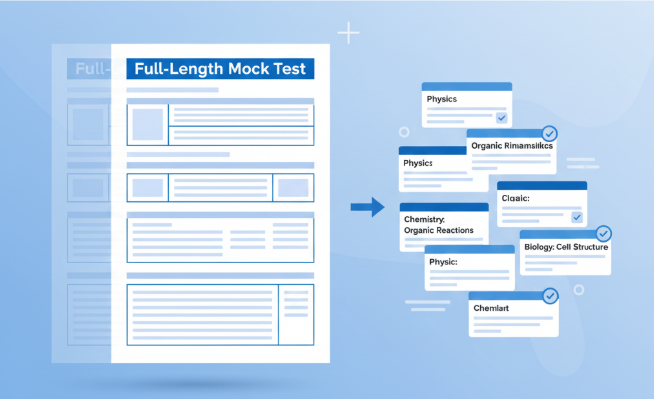
- Make the Initial Mock Tests: Do 2 full-length mock tests this week under time pressure conditions. Don’t let the scores worry you; the purpose is to assess your performance. Find out which subjects or topics are giving you the hardest time. This analysis lays the foundation of your customised NEET revision strategy for the upcoming weeks.
- Work on Previous Years’ Papers: Get yourself acquainted with the exam format and question types through solving past NEET papers. This will not only help you with the recognition of concepts that are often tested but also with the way you plan your revision.
Week 2 Practice with Strategy
The second week transitions from building knowledge, into improvements in performance and planning to work on weaknesses.
- Daily Mock Test: Set up an everyday practice of taking one complete mock test. The target isn’t improvement in content knowledge, but rather speed and accuracy. The push is now to recognise that with 180 questions and 180 minutes, you have about 1 minute per question. This practice of NEET mock tests will set you up to develop the needed stamina in preparation for the exam.
- Structured Weaknesses Improvement: Each day, set aside some time to work specifically on the topics where you made errors on the mock test. If you struggled in Physics mechanics or once again in Organic chemistry reactions, this is your opportunity to correct these issues. Refer back to your NCERT, watch “concept” videos, or use a NEET crash course for a quick response in these content areas.
- Active Memorisation: In Physics and Chemistry, create a one-system sheet of all the formulas and a chart for the reactions. Each day, use these sheets to review. Also, use mnemonics for any biological processes or for reactions in chemistry. Using active recall will increase long-term retention than the reading process.
- Clearing Up Doubts: Avoid situations without clarity. You want to clear up any of your self-created doubts to make sure you are not confused for any reason. You have to do this through your teacher, using quorums to ask questions, or if your NEET crash course provides a format to help, they may be able to answer as well.
Week 3 & 4: Final Review
The final week is about confidence-building and ensuring you’re mentally and physically prepared for the big day.
- Solve the Last 10 Years’ Papers: In these final days, solve the previous 10 years’ NEET question papers. This gives you a clear understanding of important topics and question patterns, while also serving as a confidence booster.

- Light Revision Only: Stick to revising your short notes, formulas, diagrams, and key concepts. The golden rule of this phase is to avoid learning anything new. New information at this point in time is more likely to confuse than to help.
- Reduce Test Frequency: In the last 3-4 days, get back to shorter topic-wise tests instead of full-length mocks. This keeps you engaged without causing mental fatigue.
5 SMART Study Tips for the final 30 days

Apart from the weekly schedule, if you make use of these smart NEET study tips during your 30-day preparation period, you can increase your efficiency to a great extent:
- NCERT is Non-Negotiable: This is especially true when it comes to Biology and Inorganic Chemistry, where your command over NCERT should be so strong that you can picture every page in your mind. This one NEET revision method can get you a large portion of your marks.
- Strategic Time Management in Exam: Toppers often suggest starting with Biology for quick marks and then going on to Chemistry and finally attempting Physics. But you should do it in the sequence of the subjects you have practised most in your NEET mock test routine.
- Smart Guessing Strategy: For questions you are not sure about, first eliminate the obviously wrong options. Only then, make educated guesses when you can narrow it down to two possibilities as a way to lessen the impact of negative marking.
- Focus on High-Yield Topics: Comprehensive coverage is ideal, but ensure you have revised well at least high-weightage topics like Human Physiology, Genetics, Chemical Bonding, Electrostatics and Optics.
- Mock Tests: It’s of much better value to perform an in-depth analysis of 15 mock tests than to just take 30 tests without proper thinking. A heavy analysis and light performance should be the NEET mock test routine for you.
Your Route to NEET Success
The last month of NEET preparation requires a mixture of strong self-care and intensive studying. This 30-day NEET preparation plan gives an organised NEET revision strategy, but your self-control and flexibility in applying it will be the factors determining your success. Keep in mind that, through consistency, one can achieve more than through cramming, and smart work is the right accompaniment to hard work.
Trust your preparation, whether you are following this plan alone or alongside a NEET crash course. On test day, keep quiet inside yourself, pay attention to the reading part, and distribute your time wisely. You have put in a lot of effort for this moment, just trust your skills. If you consistently apply these NEET study tips, then you will be in a great position to get the score that you deserve. Your medical journey starts with the decision to make the last 30 days count.

